What should your lifting warm-up sets do?
The goal is pretty simple: arrive at your first working set feeling primed and ready to lift, without wasting time and energy getting there.
For a heavy multi-joint exercise like a squat, bench press or deadlift, that usually means a few sets where the weight gets progressively heavier and the reps come down. You get some practice with the movement and a chance to feel the weight before your first hard set.
We’re talking specifically about warm-up sets with weights here. You might also want to do some general movement or other preparation before you start lifting, depending on what you need that day.
How do you calculate warm-up sets before lifting?
Let’s say you’re going to squat 100 kg for your working sets. The job of the warm-up is to get you from an empty bar to 85 kg without spending too much energy along the way.
Generally, I’d follow a few rules:
- Start light, with enough reps to get comfortable with the exercise.
- Make bigger jumps when the weights are easy.
- As you get closer to your working weight, make the jumps smaller.
- Do fewer reps as the weight gets heavier.
- Keep the warm-up sets well away from failure. Save the hard work for the working sets.
You don’t need a complicated formula for every lift. The exact jumps depend on the weight you’re building towards, the plates you have, and how you feel.
Example: warm-up sets for a 100 kg squat
Imagine you’re going to squat 100 kg for 3 reps at about RPE 8 (2 reps in reserve, or RIR). Assuming you’re using a 20 kg bar, here’s one way you could warm up:
- Empty bar (20 kg) × 8–10 reps
- 35 kg × 5 reps
- 70 kg × 3 reps
- 85 kg × 3 reps
- 95 kg × 3 reps
- 100 kg × 3 reps: first working set
That’s it. You haven’t done anything particularly clever. You’ve just made the weight a little more familiar while keeping most of your energy for the sets that matter.
It’s also an example, not a sequence you have to copy exactly.
I personally like to do the later warm-up sets for the same reps as my working sets (3 reps here), but some people prefer fewer reps (e.g. 1–2) on their last few warm-ups.
If you’re working up to 220 kg, you’ll probably need more jumps. Even if you’re much stronger, you’re still starting from whatever you’ve been doing before you got to the gym. If your working weight is only 60 kg, you may need fewer. If you feel awkward until you’ve had a couple of extra sets, add one. If you’ve already been doing similar exercises and feel ready, you might not need so many.
The calculator can give you a sensible starting point, but you can always adjust it.
How big should the jumps between warm-up sets be?
Early on, you can usually add quite a lot of weight because those sets are easy. As you get closer to your working weight, it makes sense to reduce the jumps so that the final warm-up doesn’t feel like a surprise.
For a 100 kg squat, our last jump was only 5 kg (~5%), from 95 to 100. Someone squatting 200 kg will usually make bigger jumps overall (5% of 200 is 10 kg), but the same idea applies.
It also depends on what percentage of your one rep max (1RM) you are warming up to. If you’re warming up to a set of 8 reps at RPE 8 (2 RIR), that’s roughly 74% of your 1RM, so you’ll generally need fewer warm-ups and can take larger jumps than if you’re warming up to 1 rep at RPE 8 (2 RIR), which is around 93% of your 1RM.
Equally, if you’re warming up to 10–12 reps (around 70% of your 1RM), you can probably just do the first one or two warm-ups, with bigger jumps. The higher the percentage of your 1RM you’re warming up to, the smaller the jumps tend to become.
How long should you rest between warm-up sets?
For the first few lighter sets, you usually won’t need to time your rest. By the time you’ve changed the plates, taken a breath and got set up again, you’re probably ready.
As you get closer to your working weight, though, give yourself a bit more time.
For a heavier multi-joint exercise, 2–3 minutes before the last warm-up and again before the first working set is a useful starting point. If you’re working up to a very heavy single or a max attempt, you might want longer.
The point is to be ready for the work. If you’re still out of breath or fatigued from the previous warm-up, take a little longer.
How many warm-up sets do you need for accessory exercises?
Probably fewer.
If you’re doing an exercise for 8 or more reps per set, one or two warm-ups at roughly 50–75% of your planned working weight may be enough. For a lighter exercise where you’re doing 12-plus reps, sometimes one set at about half of your working weight is plenty. You might not need any if you’ve already trained the same muscles earlier in the session. For example, if it’s your second biceps exercise of the session, you might be fine to just jump straight in.
Here’s a quick test: does your first working set always feel awkward, but the second or third feels much better? You might need a little more preparation before that first one.
Should you use your 1RM or your working weight to calculate warm-ups?
Either works fine. If you’re using my calculator below, it can estimate your 1RM and work out your warm-ups from there. If you’re doing it in your head, using your working weight is fine.
Especially for higher-rep sets, taking a few sensible jumps works just fine. If you’re working up towards a higher percentage of your 1RM, especially on a multi-joint exercise, thinking about the percentage jumps can give you a bit more certainty with your warm-ups.
That’s another reason I don’t like treating a warm-up calculator as a strict set of rules. It’s there to save you from having to do the maths between sets, not stop you paying attention to how you’re lifting.
What’s in the free warm-up calculator?
I've put an automatic warm-up planner and a custom warm-up planner into a Google Sheet. You can use the suggested steps or change them to suit the equipment, plate increments and jumps you prefer.
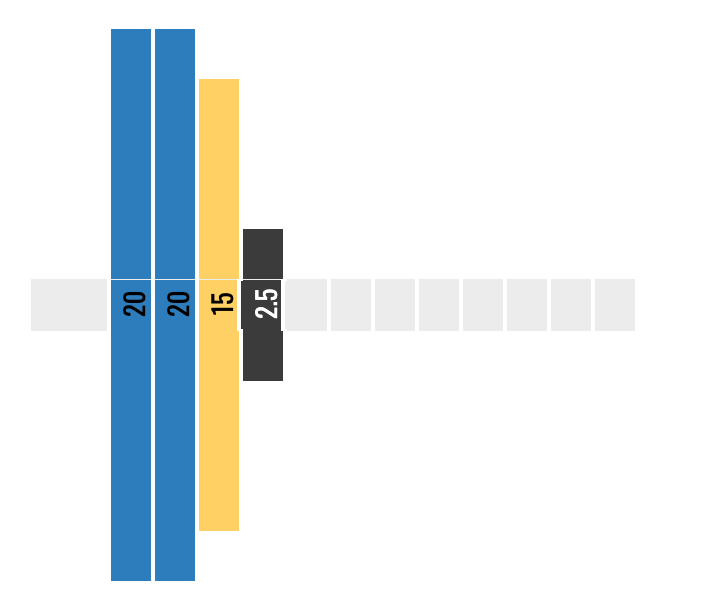
There's also a plate-loading visualiser, which is handy when you'd rather see what needs to go on the bar than do the plate maths between sets. The same sheet includes an estimated 1RM calculator, but you don't have to use it to plan your warm-ups.
The sheet opens as view-only. Choose File → Make a copy and enter your own numbers. It works in Google Sheets; downloading to Excel may not preserve every feature.